
That is why leaves appear green. This is why phytoplankton particularly cyanobacteria can thrive at the bottom of the euphotic sunlit zone where only blue light can reach.
The Light Dependent Reactions Of Photosynthesis Boundless Biology

Chlorophyll Definition Functions And Benefits Biology Dictionary

Chlorophyll Wikipedia
How does that give color.

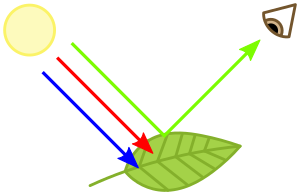
Why chlorophyll cannot absorb green light. Because of this plants appear green in color. Carotenoids on the other hand reflect yellow orange and red the colour of leaves during autumn. Chlorophyll does not absorb light in the green spectrum of light but reflects it instead.
It helps leaves to capture the ener gy of the sunlight. Carotenoids absorb in the short-wavelength blue region and reflect the longer yellow red and orange wavelengths. Why does leaf appear green.
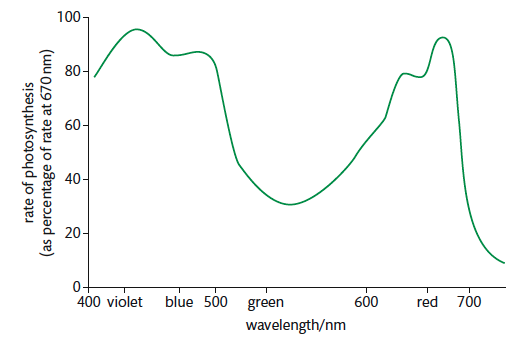
During this reaction carbon dioxide and water are converted into glucose by chlorophyll in the presence of light energy. One cannot tell from this graph but because chlorophyll a does absorb red light we can predict that it would be effective in driving photosynthesis. The leaves have a green pigment called chlorophyll.
These absorption spectra indicate that green and yellow wavelengths of light are much more effective than red light. Here complementary colors are diametrically opposite each other. Molecules of chlorophyll absorb incoming sunlight and convert that sunlight into chemical energyChlorophyll absorbs all spectrums of visible light except green so it is responsible for the green color of plants and algae.
The process cannot work without an energy input and this comes from the sun. It is this energy that is used to split water molecules into hydrogen and oxygen. Within the visible light spectrum chlorophyll strongly absorbs red and blue light while reflecting green light 48.
Which fraction of VIBGYOR is used during photosynthesis. Chlorophyll is able to absorb different light colors but cannot absorb the color green. Chlorophyll and cannot make food by photosynthesis.
Hence chlorophyll-containing tissues appear green because green light diffusively reflected by structures like cell walls is less absorbed. Absorb Red See Green TiH 2O 63 Absorbs in green yellow. Chlorophyll the important light absorbing pigment in plants does not absorb light in the green part of the spectrum.
This gives the plants their green color. Each chloroplast contains a green chemical called chlorophyll which gives leaves their green color. This is why most of the plants we see are green.
Plants are able to do photosynthesis in virtue of a special green pigment in their cells called chlorophyll. Black pigments absorb all of the wavelengths that strike them. Indian Pipe has lost the ability to produce chlorophyll which is why it cannot produce its own energy from light.
Phytoplankton the microscopic floating plants that form the basis of the entire marine food web contain chlorophyll which is why high phytoplankton concentrations can make water look green. That is why leaves appear green because light reflected from leaf to your eye is enriched in the green wavelengths relative to the blue or red. The reason why items are the color that they are is because some objects will absorb the wavelengths and others will be reflected.
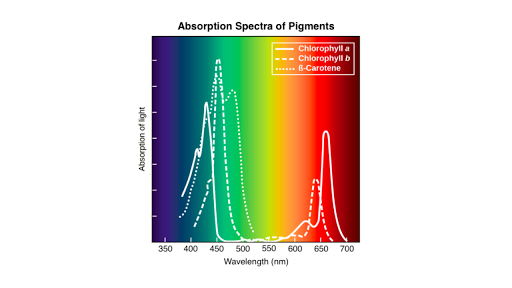
Green is unique in that it can be created by absoption close to 400 nm as well as absorption near 800 nm. Chlorophyll absorbs light and transfers its energy to parts of the plant that can use that energy. Chelang Agents Porphines like chlorophyll a are.
Chlorophyll allows us to absorb the energy needed to complete the photosynthesis process. Were actually looking at the chlorophyll thats inside of. To be more precise the chlorophyll in the leaves absorb most of this light to create food.
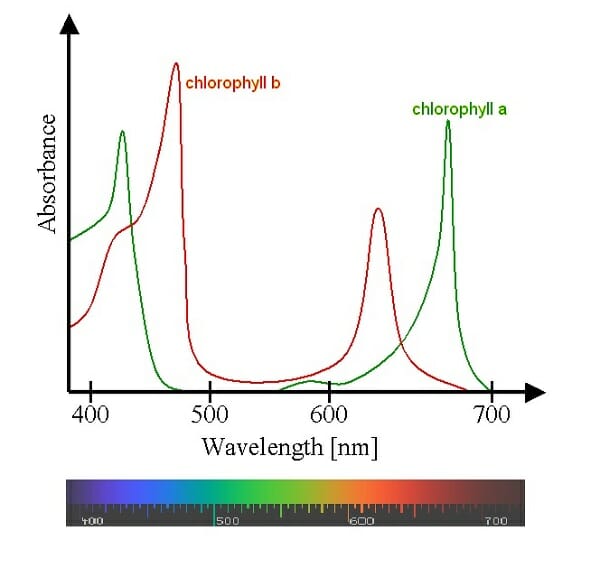
Carotenoids assist with photosynthesis by absorbing wavelengths of light. You can easily see that chlorophyll preferentially absorbs the blue and red wavelengths and does poorly in the green range. Photosynthesis is a process by which plants prepare food.
This is one reason why energy-rich UV light is considered dangerous Like the cells in the human eye the leaves in a plant also respond to the light energy falling on it within these 390-700nm wavelengths. Soil has certain bacteria that. It also gives plants their green color.
Chlorophylls absorb light most strongly in the blue portion of the electromagnetic spectrum as well as the red portion. Light Is Necessary For Photosynthesis Experiment Class 10 Introduction. The light absorbing compound in the chloroplast is a pigmentthese pigments absorb some wavelengths of light and reflect othersthe color our eyes see is the color that the pigment reflects Chlorophyll is the pigment inside the chloroplast the absorbs light.
This process is referred to as photosynthesis. Light in this range of wavelength is reflected. Chlorophyll the primary facilitator of photosynthesis absorbs blue and red light and reflects green light.
Instead it parasitizes certain species of trees and fungi and steals their nutrients. But these coordination complexes are not emitting light They absorb light. Activity 12 Take a piece of bread and moisten it with.
Photosynthesis is a process used by plants and other organisms to convert light energy into chemical energy that through cellular respiration can later be released to fuel the organisms activitiesThis chemical energy is stored in carbohydrate molecules such as sugars and starches which are synthesized from carbon dioxide and water hence the name photosynthesis from the Greek phōs. Chlorophyll a absorbs wavelengths from either end of the visible spectrum blue and red but not green. This is why leaves with chlorophyll usually appear green.
Hydrogen and carbon dioxide are used to form glucose or food for plants. During the first part of photosynthesisthe light-dependent reactionchlorophyll and other pigments harness the light energy to produce NADPH and ATP which are two types of energy-carrier molecules. For example a leaf is green because it absorbs all visible light wavelengths except for green- green is reflected.
Chlorophyll the green pigment common to all photosynthetic cells absorbs all wavelengths of visible light except green which it reflects to be detected by our eyes. NCERT Class 10 Science Lab Manual Light is Necessary for Photosynthesis. Inside in the plant cell there is a light-absorbing pigment called chlorophyll which has the role of absorbing blue and red light waves from sunlight and reflect green light waves.
Because green is reflected or transmitted chlorophyll appears green. Chlorophyll absorbs the suns energy. The sun starts the first reaction in photosynthesis which is known as the light-dependent process.
We said most of the light not all of it. Thus absorption of 420-430 nm light renders a substance yellow and absorption of 500-520 nm light makes it red. The energy absorbed from light is transferred to two kinds of energy-storing molecules.
Chlorophyll antennae and associated pigments molecules carotenoids. Chlorophylls job in a plant is to absorb lightusually sunlight. Plants cannot absorb nitr ogen in this form.
Blue and Red fraction. With the help of a chemical called chlorophyll plants are able to convert energy from the sun into chemical compounds that they can use. Oxygen is released from the leaves into the atmosphere.
During this time of year chlorophyll breaks down so the carotenoid pigments become visible. During this stage of photosynthesis as the sunlight excites the chlorophyll water is split into oxygen and hydrogen and the oxygen is released into the atmosphere. Conversely it is a poor absorber of green and near-green portions of the spectrum.
White pigmentslighter colors reflect all.
3 8 Photosynthesis 知乎
Wavelengths Of Light And Photosynthetic Pigments Article Khan Academy
Chlorophyll Causes Of Color
Is It Possible To Add Some Green Light Absorbing Pigments Eg Carotenoids To A Plant To Increase Photosynthetic Rate Quora
Chlorophyll Wikipedia
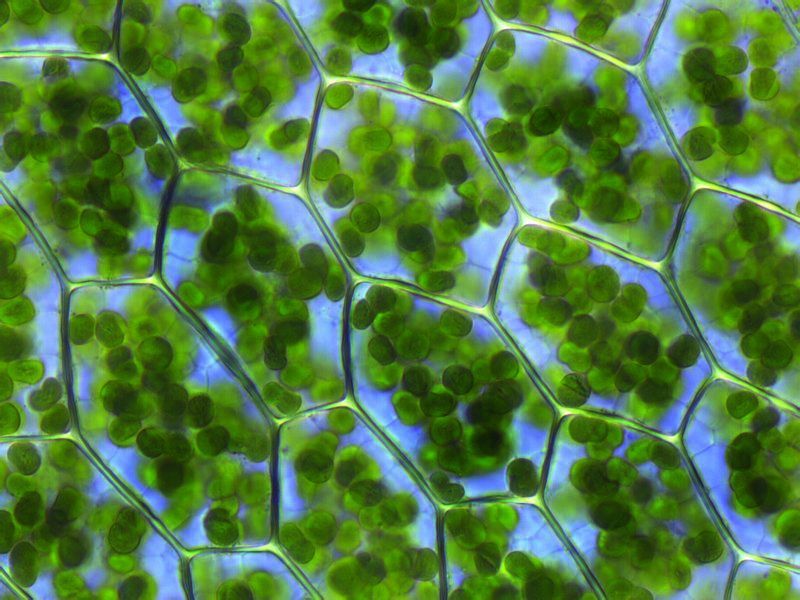
Chlorophyll National Geographic Society
Why Don T Plants Use Green Light For Photosynthesis Quora

Chlorophyll Present In Green Leaves Of Plants Absorbs Light At 4 620xx10 Youtube


